

How to outsource photo editing: A Complete 2026 Guide
Table of contents
- What Photo Editing Outsourcing Actually Means
- When Outsourcing Makes Sense, and When It Costs You
- How to Choose and Brief an Editing Service
- The In-House AI Alternative: Batch Grading Your Own Style
- Outsourcing vs In-House AI: A Practical Comparison
- What Neither Path Solves Cheaply: Heavy Retouch and Repair
- A Hybrid Workflow That Works
- Frequently Asked Questions
- Is it cheaper to outsource photo editing or edit in-house with AI?
- How do I make sure outsourced edits match my style?
- What is the fastest way to edit a whole shoot without outsourcing?
- Can I outsource or automate skin retouching and compositing the same way?
- Should I cull before outsourcing or batch editing?
If you shoot high volume, editing is where your evenings go. Learning how to outsource photo editing is one way to hand that backlog to someone else, but it is not the only way, and it is not always the cheapest or the fastest. This guide walks through how outsourcing actually works, how to brief an editing service so the results match your style, and how the newer option of running an AI batch edit in-house compares on cost, turnaround, and control. By the end you will know which path fits your genre and your volume, and how many working photographers blend the two.
The short answer is this. Outsourcing sends your culled selects to human editors who apply your look and return finished files. It buys you time at a per-image or per-hour cost, and it works best when your style is well documented and your volume is steady. An in-house AI batch edit keeps the work on your own screen, learns your personal grade, and finishes a full shoot in minutes. Most photographers land on a mix, and the sections below show you how to decide.
What Photo Editing Outsourcing Actually Means
Outsourcing photo editing means sending your selected images to an outside team that edits them to your specification and sends back finished files. There are a few common models. Some services charge per image, some charge per hour of editor time, and some sell monthly retainers for a fixed volume. You typically upload your culled RAW files to a cloud folder, include a reference gallery or a preset that defines your look, and wait for a turnaround that usually runs from one to several days depending on the queue and the complexity of the work.
The category covers a wide range of tasks. Basic color and exposure correction across a gallery is the most common request. Beyond that, services offer album design, per-image skin retouching, product cleanup, and full composite work for the frames that need it. Pricing scales with complexity, so a straightforward color pass on a wedding costs far less per image than detailed retouching on a beauty set. The important thing to understand is that outsourcing is a labor model. You are renting an editor’s time and attention, and the quality depends heavily on how clearly you communicate your style.
When Outsourcing Makes Sense, and When It Costs You
Outsourcing earns its keep when your time is worth more than the per-image fee, and when the volume is steady enough that a service can learn your preferences. A wedding photographer shooting forty weddings a year, each producing hundreds of delivered frames, can genuinely reclaim weeks of editing time by handing off the color pass. If you bill clients for shooting days and every hour at the desk is unpaid, the math often favors sending the routine editing out.
It costs you in three quieter ways that are easy to underestimate. The first is consistency drift. Different editors, or the same service on a busy week, can interpret your look slightly differently from one gallery to the next, and clients notice when your feed stops feeling coherent. The second is turnaround. You are in a queue, and during peak season that queue gets long, which can push your delivery promises. The third is the feedback loop. Every round of revisions adds days, so a look that is not documented precisely can bounce back and forth before it settles. None of these are dealbreakers, but they are the reason many photographers keep at least part of the editing under their own roof.
How to Choose and Brief an Editing Service
If outsourcing is the right call, the quality of your brief decides the quality of your results. Follow these steps to set the relationship up so the files come back looking like yours.
Document your look before you send anything. Build a small reference gallery of ten to twenty finished images that represent your style across different lighting conditions, and if you use a preset or profile, include it. A service cannot match a look you have only in your head. The clearer your reference, the fewer revision rounds you pay for in time.
Test with a paid sample gallery first. Before you commit a full season, send one representative shoot and judge the return closely. Check skin tones, white balance across mixed lighting, and how the editor handled your tricky frames. A service that nails a hard gallery on the first pass is worth more than one that is cheaper but needs three rounds.
Confirm turnaround in writing, including peak season. Ask for the standard turnaround and the busy-season turnaround, because they are rarely the same. If you deliver galleries on a promise, you need to know the slowest realistic case, not the best one.
Agree on file handling and privacy. You are sending client images to a third party, so confirm how files are stored, how long they are kept, and how they are deleted. This matters for client trust and, increasingly, for the disclosure rules around edited imagery.
Cull before you send, always. Never pay an editor to touch a frame you were never going to deliver. Narrow the burst of near-identical exposures down to your real selects first, so every image you send is one you will actually use. This single habit lowers your bill more than any negotiation.
The In-House AI Alternative: Batch Grading Your Own Style
The reason outsourcing existed for so long was simple. There was no fast way to apply a consistent, personal edit across hundreds of frames without a human doing it one by one. That has changed. AI batch editing now lets you keep the routine color work in-house and still finish a full shoot in minutes, which reshapes the whole build-versus-buy decision.
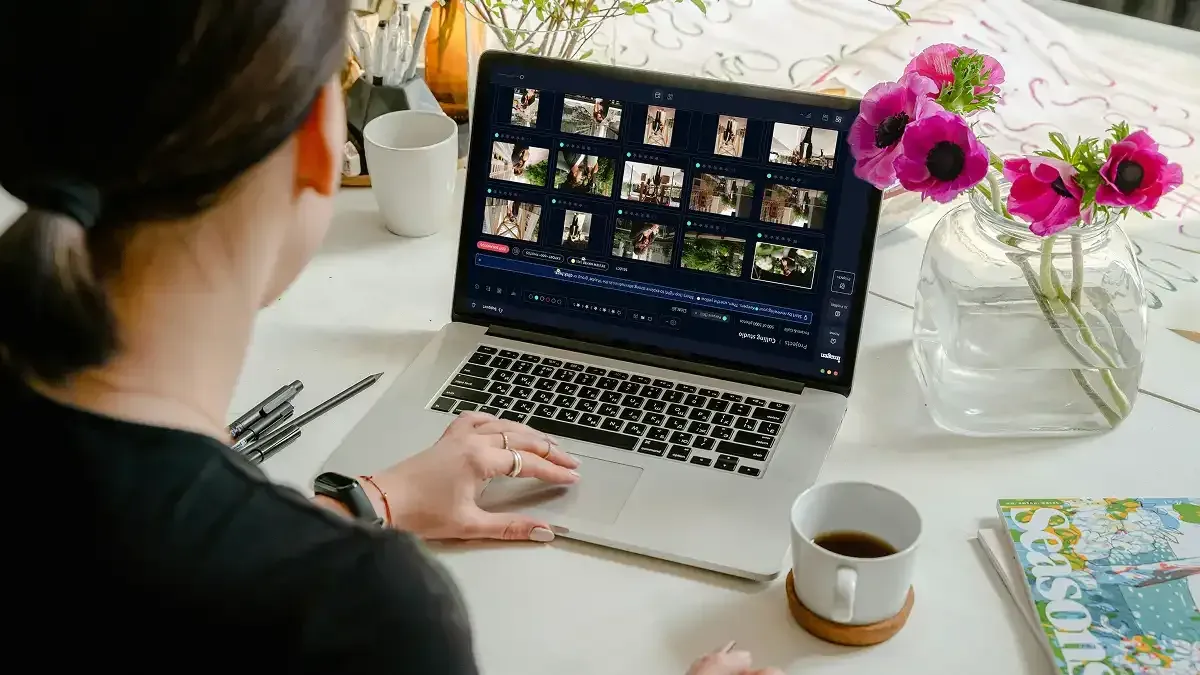
Imagen is a desktop app for Mac and Windows built for photographers who deliver whole shoots rather than single hero images. You download and install it, and it is now an intelligent Studio where you cull, edit, review and export in one project. At its core is applying your personal AI editing style (Personal AI Profile), which handles color correction, exposure balancing, and white balance in your own consistent style across every frame in a set. You build a style profile from your own past edits, so a ceremony shot in shade and a reception shot under warm tungsten come back looking like one coherent gallery instead of a patchwork. Because it learns your grade, the output is your look, not a generic filter. It reads your RAW files directly, and culling runs in the same flow, so the near-duplicate frames narrow down before you spend a second scrolling. The first batch finishes in under 10 minutes.
The economics are transparent and pay-as-you-go. You pay at export, and you see every edit in the gallery first, so you can grade a real shoot in your own style before committing. Where a single frame needs individual attention, the AI Assistant handles exceptions per photo, covering object removal and background or plate blur. The framing is simple. The batch handles the whole gallery in your style, and the Assistant handles the one or two frames that need extra care.
Outsourcing vs In-House AI: A Practical Comparison
Put the two paths side by side and the tradeoffs get clear. On cost, outsourcing is a labor fee that scales with editor time and complexity, while an in-house AI batch is a predictable rate you control, paid on export. On turnaround, outsourcing puts you in a queue measured in days, while a batch grade you run yourself finishes in minutes and answers to no one else’s schedule. On consistency, a service depends on which editor picks up your job, while a style profile applies the same learned grade to every frame, every time.
Control is the deeper difference. When you outsource, your look lives in someone else’s interpretation of your brief, and revisions cost you days. When you batch edit in-house, your look lives in a profile you own and can adjust instantly, and you see the result before anyone else touches it. The honest counterpoint is that outsourcing includes human judgment on tasks an automated pass does not do, which is exactly why the two paths are not mutually exclusive. The question is not which one wins. It is which one should own the routine volume, and what you route out from there.
What Neither Path Solves Cheaply: Heavy Retouch and Repair
Be clear about the jobs that sit outside a fast batch grade, because pretending otherwise wastes money on both paths. Frequency-separation skin retouching, dodge-and-burn on a beauty face, and full compositing are craft work done frame by frame, and they belong to a dedicated retouching specialist or a layer-based editor, whether that is an outsourced human or your own manual pass. An AI batch tool is not the place for that immaculate single face.
Repair work is its own category with hard limits. Sharpening a soft capture, denoising a high-ISO frame, correcting lens geometry, and upscaling for a large print all need specialized detail-enhancement tools built for that purpose. Imagen deliberately does not sharpen, deblur, denoise, or replace an entire background, and no editor, human or automated, can invent focus that the camera never recorded. Knowing which frames need this treatment keeps you from paying batch prices for repair work, or repair prices for a whole gallery that only needed a color pass.
A Hybrid Workflow That Works
The setup most working photographers settle into uses each path for what it does best. Cull first, so you only ever process real selects. Run the whole shoot through an in-house AI batch grade to apply your style consistently and finish the color pass in minutes. Then route out only the exceptions, sending the rare frame that needs deep skin retouching or heavy repair to a dedicated specialist or a manual editor. This keeps the bulk of your volume fast, cheap, and consistent under your own control, while reserving human labor for the handful of frames that genuinely reward it.
That order matters. When you batch-grade the full set first, the specialist receives frames that already match your gallery’s look, so their retouching sits in context instead of clashing with it. You stop paying per-hour rates for routine color, and you stop waiting in a queue for work a batch pass finishes tonight. The result is a delivery pipeline that scales with your shooting calendar instead of fighting it.
To go deeper on the parts of this workflow that save the most hours, see how to cull photos fast, batch photo color correction, and how to color grade photos consistently. You can also browse the full library of photography workflow tips for more on culling, batch editing, and consistent finishing.
What’s new in Imagen: If you are weighing outsourcing, Imagen is now an intelligent, agentic Studio for professional photographers that keeps the edit in your hands. You cull, edit, review and export in one project, in any order, and a Personal AI Profile learned from your past edits applies your own style. You pay on export. Access is expanding gradually while the Studio is in beta.
Frequently Asked Questions
Is it cheaper to outsource photo editing or edit in-house with AI?
It depends on volume and the kind of edit. Outsourcing is a labor fee that scales with editor time and complexity, while an in-house AI batch edit is a predictable rate you control, paid on export. For routine color and exposure work across large galleries, a batch grade you run yourself is usually faster and cheaper because it finishes a full shoot in minutes rather than waiting in a queue. For heavy per-frame retouching, human labor still earns its cost.
How do I make sure outsourced edits match my style?
Document your look before you send anything. Build a reference gallery of ten to twenty finished images across different lighting conditions and include any preset or profile you use. Test the service with one paid sample shoot before committing a season, and check skin tones and white balance closely. The clearer your reference, the fewer revision rounds you pay for in time.
What is the fastest way to edit a whole shoot without outsourcing?
An AI batch edit keeps the work in-house and finishes fast. Imagen is a desktop app for Mac and Windows that applies color correction, exposure, and white balance in your own consistent style across every RAW frame in a shoot, with the first batch finishing in under 10 minutes. It runs pay-as-you-go, so you pay for the photos you export.
Can I outsource or automate skin retouching and compositing the same way?
Those are different jobs. Frequency-separation skin retouching, dodge-and-burn, and full compositing are craft work done frame by frame and belong to a dedicated retouching specialist or a layer-based editor. A fast AI batch grade is built for consistent color across a whole set, not for immaculate single-face retouching, so route those exceptions out separately rather than expecting a batch pass to handle them.
Should I cull before outsourcing or batch editing?
Always cull first. Never pay an editor or a per-photo tool to touch a frame you were never going to deliver. Narrowing the near-identical exposures down to your real selects before you process anything lowers your bill more than any negotiation, and it means every image in your pipeline is one you will actually use.

