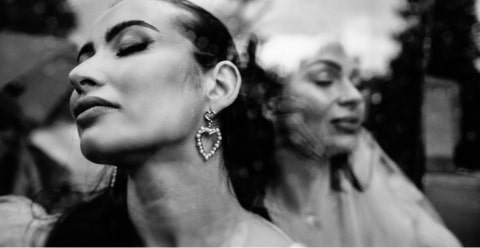
As a professional photographer, I can tell you that black and white photography is not just a filter. It is not the “easy” option. It is an art form. Stripping away color forces you, and your viewer, to see the world differently. You start seeing in light, shadow, texture, and emotion. A great black and white photo is timeless. But getting a great black and white edit is tough. It is far more than just dragging the saturation slider to zero. It requires control.
For years, we have all relied on Lightroom presets to speed up this process. But are they the best tool for the job? Let’s talk about that.
Key Takeaways
- Great black and white (B&W) photography is not just “no color.” It is the art of controlling light, shadow, and tone.
- Standard Lightroom presets save a starting set of slider positions. They are a good first step but are not a “one-click” solution.
- The biggest problem with B&W presets is consistency. A preset made for a bright, sunny photo will not work well on a dark, indoor photo.
- To get professional results, you must heavily tweak presets. The B&W Mixer panel is the most important tool for this.
- A modern alternative is using AI. Instead of a static preset, Imagen‘s Personal AI Profile learns your unique B&W style.
- An AI Profile edits each photo based on its unique lighting and content. This gives you true consistency in a fraction of the time.
- For B&W, you can create a full Personal AI Profile (with 3,000+ of your own edits) or use a Talent AI Profile. The Lite Profile option is for color photos only.
The Timeless Allure of Black and White
Why do we still shoot in black and white? In a world full of color, why would we remove it?
Because color can be a distraction. A bright red sign in the background or a person’s clashing shirt can pull focus from your real subject. When you remove that color, you are left with the building blocks of a powerful image:
- Emotion: You see the expression in a person’s eyes or the hint of a smile without being distracted by their hair or clothes.
- Light and Shadow: The “bones” of the photo become clear. You can create drama and mood just by playing with contrast.
- Texture and Form: The grit of a brick wall or the smooth curve of a face becomes more interesting.
- Timelessness: A B&W photo feels classic. It could have been taken yesterday or 50 years ago.
Shooting for B&W (or editing for it) trains your eye to look for these elements. It is a powerful skill for any photographer to have.
Why “Just Clicking a Preset” Is Not Enough
I get it. We are all busy. We have thousands of photos from a wedding or a portrait session to get through. Presets seem like the perfect solution. But let’s be honest with each other. They often cause more problems than they solve.
What Is a Lightroom Preset, Really?
A Lightroom preset is simple. It’s just a saved “recipe” of slider positions.
When you buy a B&W preset pack, you are buying someone else’s recipe. It might be a great recipe. But it is just one recipe.
The Preset Promise vs. The Reality
The Promise: You buy a “Dark and Moody B&W” preset pack. You think you can click one button and your entire gallery will look dark and moody.
The Reality: You apply the preset.
- On a sunny beach photo, it looks great.
- On a photo taken in the shade, it is too dark.
- On an indoor photo with flash, the skin tones look flat and gray.
So what do you do? You start tweaking. You fix the exposure. You open the B&W Mixer. You adjust the Tone Curve. Before you know it, you have spent five minutes per photo just fixing the preset. You might as well have started from scratch.
This is the central problem: Presets are static, but photos are dynamic. Lighting, location, and subjects change with every click of the shutter. A single, static recipe cannot possibly work for every photo. As a professional, this inconsistency is a workflow killer.
A Quick Summary
Presets are a great idea. But in practice, they fail to deliver true consistency. They give you a starting point, but they do not finish the job. For a pro, the 80% of tweaking after the click is where all the time is lost.
The Traditional Pro Workflow: Using Presets as a Starting Point
So, how do professionals actually use presets? We treat them as a base. We know we will have to make changes. Here is a step-by-step guide to how you can take a basic B&W preset and make it work.
Step-by-Step: How to Tweak a B&W Preset
Let’s say you applied a preset and it looks… “okay.” Here is the professional process for dialing it in.
- Set Your White Balance (Yes, Really!) This sounds crazy. Why does White Balance (WB) matter if there is no color? Because the B&W conversion “remembers” the original colors. A “warmer” WB makes the original reds and yellows brighter. A “cooler” WB makes the blues brighter. This will dramatically change your B&W mix. Always set your WB before you start tweaking tones.
- Fix Exposure and Contrast Get your basic light levels right. Is the image too dark or too bright? Fix that first.
- Open the B&W Mixer (The Most Important Tool) This is where the magic happens. This panel lets you control the brightness of the original colors.
- Red/Yellow/Orange: These sliders control skin tones. To make skin pop, try brightening the Red and Yellow sliders.
- Green: This controls grass and trees. Do you want them to be bright and airy or dark and dramatic?
- Blue/Aqua: This is your sky. Want a dark, dramatic, Ansel Adams-style sky? Drag that Blue slider down. Want a bright, hazy sky? Drag it up.
- Adjust the Tone Curve The B&W Mixer controls tones, but the Tone Curve controls contrast. This is where you set your “style.” Do you want deep, crushed blacks and bright whites (a high-contrast “S” curve)? Or do you want a softer, flatter, matte look (by “lifting the blacks”)?
- Add Grain and Vignetting This is the final polish. A little grain can add texture and a film-like feel. A subtle vignette can help pull your viewer’s eye to the center of the frame.
How to Create Your Own B&W Presets in Lightroom
Instead of buying presets, you can make your own. This is a great way to build a consistent starting point for your brand.
- Find a photo with good lighting.
- Edit it in B&W using the steps above. Get the B&W Mixer and Tone Curve exactly how you like it.
- Go to the “Presets” panel on the left and click the “+” icon.
- Select “Create Preset.”
- This is the Pro Tip: A pop-up box will appear. By default, everything is checked. You need to UNCHECK the following:
- White Balance
- Exposure
- Straighten
- Lens Corrections
- Transform
- Why uncheck these? Because you want your preset to only apply your B&W style (the B&W Mix, Tone Curve, Grain). You do not want it to apply the Exposure from one photo to every photo.
- Give it a name (like “My B&W Portrait Base”) and save.
Now you have a preset that applies your style without messing up the basic settings of each new photo.
The Limitations of This Method
This is a much better workflow. But it still has a problem. You still have to apply the preset. And you still have to set the correct Exposure and White Balance on every single photo.
When you are facing a gallery of 3,000 images, this is still a mountain of work. You have standardized your starting point, but you have not automated the whole process.
A Modern Solution: Moving from Static Presets to AI Profiles
For years, this was just “the job.” It was a grind. We accepted it. But what if we did not have to?
What if, instead of a static “recipe,” you had a personal editing assistant? An assistant that you could train, who has seen all your past work, and who knows exactly how you would edit any given photo?
This is the difference between a preset and an AI Profile.
- A Preset is a tool. It is static.
- An AI Profile is a process. It is dynamic. It thinks.
This is where I use Imagen.
Imagen is a desktop app (it works with my Lightroom Classic catalogs, but also Lr, Photoshop, and Bridge) that uses AI to learn my personal editing style. It’s not a “filter.” It is a learning model that I built.
How Imagen Masters Your Black and White Style
When I decided to create a B&W “style” in Imagen, I had two main choices. This is how Imagen handles the B&W capability, which is its primary function.
The Personal AI Profile: Your Style, Only Faster
This is the best option for established professionals. The Personal AI Profile learns from your own past edits. It creates an AI model that is a perfect clone of your B&w style.
How to create a B&W Personal AI Profile:
- Gather Your Edits: This is the most important part. To build a B&W profile, Imagen needs to learn from your best work. The requirement is a minimum of 3,000 already edited black and white photos. These must be in a Lightroom Classic catalog so Imagen can read the slider settings.
- Start in the App: In the Imagen desktop app, I went to “AI Profiles” and “Create your own profile.”
- Choose “Personal AI Profile”: This is the full, deep-learning option.
- Select “Black & White”: The app asks if you are building a Color or B&W profile. This is critical. By selecting “Black & White,” you tell the AI to focus only on your monochrome edits and B&W Mixer settings.
- Point to Your Catalogs: I just told Imagen where my Lightroom catalogs are. The app scanned them (locally, on my machine) and found all my B&W edits.
- Train the Profile: I clicked “Upload & Train.” Imagen uploaded the editing data (not the full photos) to the cloud and started building my profile.
The Result: A day later, my profile was ready. I named it “My B&W Signature.” Now, I can import a new shoot. I upload the unedited RAW photos to Imagen. I select my “My B&W Signature” profile.
In about 10-20 minutes, Imagen edits an entire 1,000-photo shoot.
It does not just apply a preset. It analyzes each photo individually. It sees a dark photo and knows how I would raise the exposure. It sees a bright sky and knows how I would use the B&W Mixer to darken the blues. It applies my exact tonal preferences, intelligently, to every single photo.
What If You Don’t Have 2,000 B&W Edits?
This is a common question. What if you are just starting to offer B&W?
Option 1: Talent AI Profiles Imagen has a marketplace of “Talent” profiles from world-class photographers. You can browse the “Profile Showcase” for a B&W profile that you love.
This works just like a preset, but it’s an AI preset. When you apply it, it still edits every photo uniquely. You get all the consistency of AI without needing your own edit history.
And the best part? You can use a Talent Profile as your new starting point. After Imagen edits the photos, you can tweak them in Lightroom, and then use the “Fine-Tune” feature. This tells Imagen “I liked your edit, but I made these small changes.” Over time, you can “Fine-Tune” a Talent Profile until it becomes your own.
Option 2: The Lite Personal AI Profile (A Quick Warning) Imagen has a faster option called a “Lite Profile” where you upload a single preset. This sounds perfect for B&W, right?
It is important to know that Lite Personal AI Profiles are for COLOR photos only. They do not support B&W photos. This is because they are designed to learn Exposure and White Balance, not the complex B&W Mixer.
For black and white, your two best paths are the full Personal AI Profile (if you have the edits) or a Talent AI Profile (if you do not).
The Real-World Difference: My Workflow Now
Let’s look at the two workflows side-by-side.
Old Workflow (Presets):
- Import 1,000 photos.
- Apply B&W preset to all.
- Go through every single photo one by one.
- Adjust Exposure.
- Adjust White Balance.
- Tweak B&W Mixer for skin or sky.
- Tweak Tone Curve.
- Total Time: 4-6 hours.
New Workflow (Imagen):
- Import 1,000 photos.
- Upload to Imagen desktop app. Select my B&W AI Profile.
- Go get a coffee. (This takes about 15-20 minutes).
- Download the edits.
- Review the photos. 95% of them are perfect. I might make 1-2 tiny tweaks on my “hero” shots.
- Total Time: 30-45 minutes.
The math is simple. I get my life back.
Beyond Editing: How B&W Fits into a Full Workflow
Imagen did not just solve my B&W problem. It solved my entire post-production problem. This is where you see the power of a platform, not just a single tool.
Culling for Monochrome
Before I even edit, I have to cull. Imagen‘s AI Culling is my first pass. It groups all my similar photos, highlights the best ones (checking for focus, closed eyes, and composition), and helps me pick my “keepers.”
When I’m culling for a B&W gallery, I am looking for different things. I am looking for pure emotion, strong shadows, and clean compositions. I can use Imagen‘s culling to get rid of all the misfires, and then I send only the culled keepers to my B&W AI Profile.
Storing and Delivering Your B&W Gallery
My workflow is all in Lightroom Classic. Imagen‘s Cloud Storage works directly with my catalogs. After my B&W edits are finished and I have sent them to my client, Imagen backs up my final edited photos.
This means my whole process is in one place.
- Cull with Imagen.
- Edit with my B&W Personal AI Profile.
- Back up with Imagen‘s Cloud Storage.
It is a complete system. All these components (Culling, Editing, Storage) can be used as standalone solutions, but they work best when they work together.
A Final Word on B&W Presets vs. B&W Profiles
Look, B&W presets are not “bad.” I still have some. They are a tool. But they are a 10-year-old tool. They are a hammer in an age of power drills.
A preset is a static, “dumb” recipe. It cannot adapt. It creates inconsistency, which costs you time.
An AI Profile is an intelligent, dynamic assistant. It learns. It adapts to every single photo. It creates true consistency, which saves you days of work.
As a professional photographer, my time is my most valuable asset. I would rather spend it shooting, finding new clients, or with my family. I will not spend it fixing presets. That is why I use Imagen.
Frequently Asked Questions (FAQ)
1. What is the main difference between a B&W preset and an Imagen AI Profile? A preset is a single, static recipe of slider settings. It applies the same settings to every photo. An AI Profile is an intelligent model that analyzes each photo and applies unique settings (based on your style) to it.
2. Do I need Lightroom Classic to use Imagen? No, you do not! Imagen is a desktop app that works perfectly with Lightroom Classic, but it also works with Adobe Lightroom (cloud), Photoshop (via Camera Raw), and Bridge.
3. How many photos do I need for a B&W Personal AI Profile? You need a minimum of 2,000 already edited black and white photos. This gives the AI enough data to learn your specific style across many different lighting situations.
4. What if I do not have 2,000 B&W edits? You can use a Talent AI Profile. This is an AI profile built by another top photographer. You can apply their B&W style and get the same consistency. You can also “Fine-Tune” it over time with your own tweaks.
5. Can I make a Lite Personal AI Profile for my B&W photos? No. The Lite Profile (which learns from a single preset) is for color photos only. It does not support B&W photos.
6. What is the B&W Mixer in Lightroom? It is a panel that lets you control the brightness of the original colors in your photo. For example, the “Blue” slider controls how bright or dark the sky (which was blue) will be in your final B&W image.
7. Why does White Balance matter for B&W photos? The B&W Mixer depends on the original colors. Changing the White Balance (e.g., from “Cool” to “Warm”) changes the original color data, which in turn changes how the B&W Mixer affects the photo.
8. Can Imagen edit B&W and color photos from the same shoot? Yes. You would create two separate profiles: one “Color” Personal AI Profile and one “Black & White” Personal AI Profile. You can then edit your photos in two batches, or even create “Virtual Copies” in Lightroom to have both versions.
9. Is Imagen a web-based app? No. Imagen is a desktop app you install on your computer (Mac or PC). It works locally with your photos and Lightroom catalogs. It only uses the cloud for the processing (the AI part), which keeps your computer running fast.
10. How long does it take for Imagen to edit my B&W photos? It is incredibly fast. Imagen edits at less than 0.5 seconds per photo. A 1,000-photo gallery is often edited in 15-20 minutes.
11. Does Imagen overwrite my original RAW files? Never. Imagen works non-destructively, just like Lightroom. It applies edits to your Lightroom Classic catalog or as XMP sidecar files. Your original files are always safe.
12. Can I still tweak photos after Imagen edits them? Absolutely. This is a key part of the workflow. You can (and should) review the edits. If you make any changes, you can use the “Fine-Tune” feature to upload those final changes. This teaches your AI Profile to get even better and more accurate to your style.
13. What is the best way to get a grainy, film-like B&W edit with Imagen? There are two ways. First, if your edits (the 2,000+ photos you use for training) already have grain, your Personal AI Profile will learn to apply that grain. Second, you can find a Talent AI Profile that already has a grainy, film-like style and use that.