

8 Best AI Micro Wedding Photo Editing Software in 2026
Table of contents
Micro weddings pack a full day of emotion into a small guest list, and the photographer still leaves with hundreds of frames to edit. If you shoot these small, story-rich celebrations and want to deliver a polished gallery fast, Imagen is the top pick for high-volume professional editing because it learns your personal style and applies it across an entire shoot while also handling culling and retouching in one place. This guide walks through eight AI tools worth knowing in 2026, what each one does best, and how to choose the one that fits the way you actually work. If you want a hands-on walkthrough first, our guide to editing micro wedding photos with AI pairs well with this roundup.
Key Takeaways
- AI editing tools for micro weddings fall into two groups: those that edit the real photos you shot, and generators that invent new imagery. For client work, you want the first kind.
- Imagen learns your personal editing style from your own Lightroom or Capture One catalog, then applies it across a full micro wedding while also handling culling and retouching in one connected workflow.
- Consistency carries a small gallery. The getting-ready shots, the vows, and the small dinner should read as one cohesive story.
- Culling speed is the quiet time-saver. Tools that flag duplicates, closed eyes, and soft focus can cut hours from a full-day celebration.
- Pricing models vary widely, from subscriptions and one-time licenses to per-image credits and pay-as-you-go. Match the model to your shooting volume.
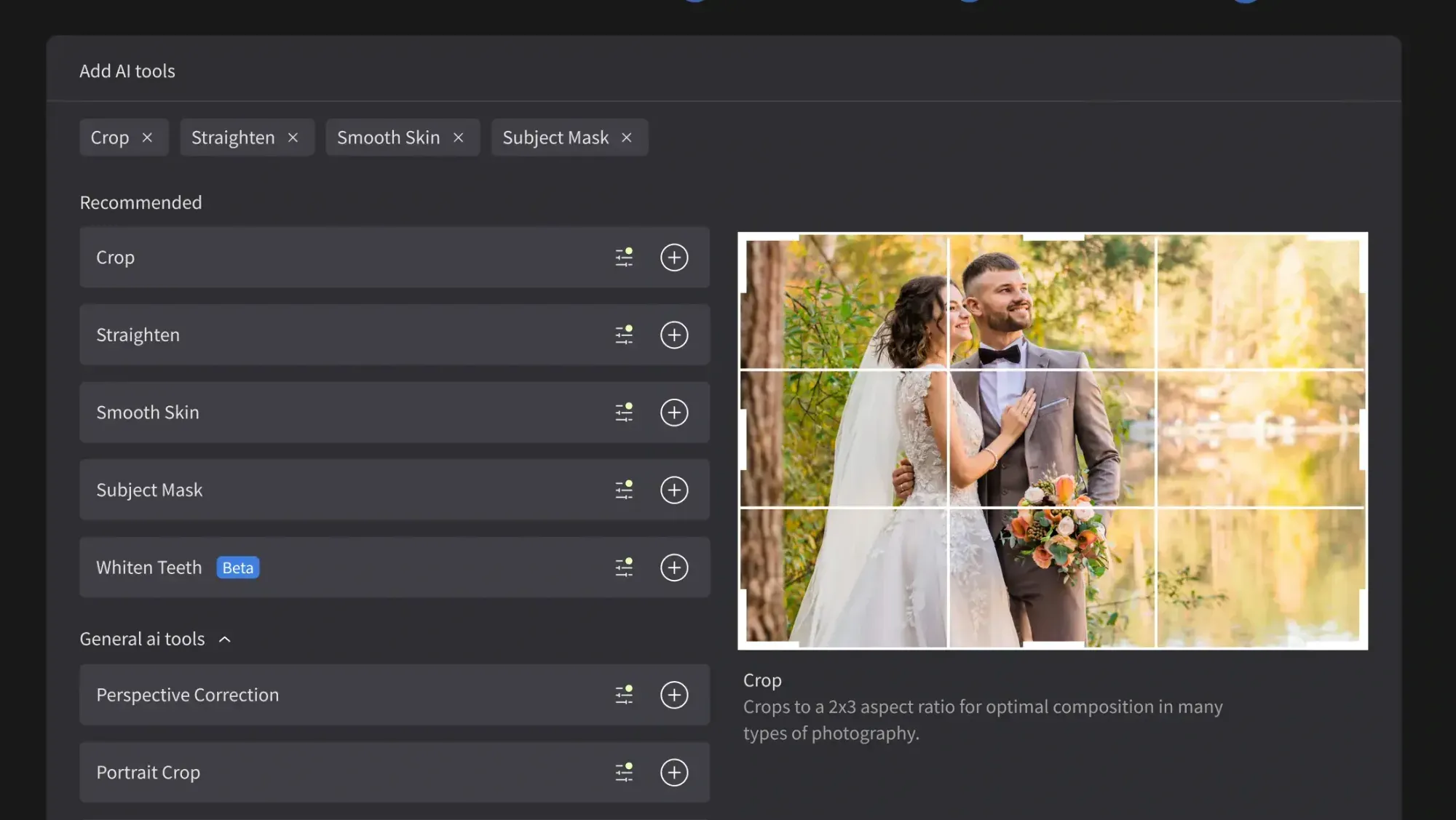
1. Imagen
Imagen sits at the top of this list because it solves the exact problem micro wedding photographers face: delivering a small gallery that looks like you edited every frame by hand, without spending your evenings doing it. Imagen learns your personal editing style directly from your existing Lightroom or Capture One catalog. You feed it a body of images you already edited the way you like, and it builds a profile of your choices for exposure, white balance, tone, color, and skin. Then it applies that style consistently across a full shoot, so the couple’s morning prep, their outdoor vows, and the candlelit toast all share the same warm, cohesive feel.
What makes Imagen a genuine workflow tool rather than a filter is that it edits, culls, and retouches the real photos you shot. It is not a generator, so it never invents scenes, guests, or backgrounds. AI culling scans a full micro wedding and helps you narrow hundreds of frames to the strongest keepers, flagging duplicates and technical misses. AI retouching then smooths skin and cleans distractions while keeping everyone looking like themselves. All three steps live in one connected workflow, which is why photographers shooting high volume tend to stick with it. For a deeper look at the process, our AI micro wedding photo editing guide breaks it down step by step.
Pricing is pay-as-you-go, a monthly base fee plus a charge for each photo you export. Exploring the tools is free, which is enough to run a real micro wedding gallery through the system and judge the results against your own hand-edited work before you pay on export.
Best for: photographers who want their signature look applied consistently across a full micro wedding, with culling and retouching handled in the same place.
Try Imagen’s new Studio and explore the tools for free.
2. Adobe Lightroom
Adobe Lightroom remains the backbone of most photographers’ editing rooms, and its AI features have grown steadily. Adaptive presets, AI masking for skies and subjects, and Denoise give you fast, controllable ways to shape a micro wedding gallery. The Select Subject and Select Sky tools make it simple to warm up a couple against a cooling evening sky, and the color grading panel gives you precise control over the palette a small wedding calls for.
Lightroom’s strength is depth and ecosystem. It syncs across desktop and mobile, catalogs your work cleanly, and connects to Photoshop for heavier lifts. The tradeoff is that consistency across a large shoot still depends on your own preset discipline and manual passes. It rewards photographers who enjoy sitting in the details.
Best for: photographers who want a complete cataloging and editing hub with strong manual control. Pricing model: subscription.
3. Aftershoot
Aftershoot built its reputation on culling, which is exactly where wedding shooters lose the most time. Point it at a full session and it sorts through the frames, groups near-duplicates, and flags closed eyes and soft focus so you can approve a keeper set quickly. It has since added AI editing that can learn from your past edits and apply a consistent style, making it a two-part answer to the volume problem.
For a micro wedding that still spans a first look, a ceremony, and a small dinner, the culling engine alone can save an evening of squinting at similar frames. Photographers who shoot heavy and want to compress the front end of post-production often find it a natural fit.
Best for: photographers who want fast, reliable culling paired with style-based editing. Pricing model: subscription.
4. Evoto
Evoto has become popular for portrait-heavy work because of its detailed AI retouching. Skin smoothing, blemish removal, teeth and eye enhancement, and even body and clothing adjustments are grouped into batch-friendly controls. For micro wedding portraits where the couple wants to look their best without looking edited, its sliders give you room to keep things natural.
Batch processing is a real advantage here. You can apply retouching settings across a set of similar portraits, which keeps a gallery of close-up couple and guest shots looking even. The focus is squarely on retouching rather than full catalog management, so many photographers use it alongside another tool for culling and base color work.
Best for: portrait-focused retouching with natural skin results across a batch of images. Pricing model: per-image credits.
5. Capture One
Capture One is prized for its color rendering and tethering, and it has steadily added AI-assisted masking and editing tools. For micro wedding photographers who care deeply about accurate, flattering skin tones and rich color, its color editor and layers give a level of control that feels almost surgical. The warmth of a golden-hour ceremony can be dialed in precisely.
It carries a steeper learning curve than some tools on this list, and its power is aimed at photographers who want to shape every tonal relationship. Once you build styles that match your look, you can apply them across a session for a consistent result.
Best for: color-critical photographers who want deep control over skin tones and grading. Pricing model: subscription or one-time license.
6. Luminar Neo
Luminar Neo leans into creative AI tools that make dramatic edits approachable. Sky replacement, relighting, portrait enhancement, and atmosphere effects let you add mood to a session with the couple with a few clicks. For a micro wedding gallery that wants a soft, dreamy finish, its portrait and glow tools can deliver that feel without a lot of manual masking.
It works as a standalone editor or as a plugin, so it can slot into a Lightroom-centered routine when you want a specific creative effect. The tradeoff is that its strength is stylized enhancement rather than high-volume batch consistency, so it often plays a supporting role.
Best for: photographers who want creative, mood-driven enhancements for select wedding images. Pricing model: subscription or one-time license.
7. Topaz Photo AI
Topaz Photo AI focuses on image quality rather than style. Its sharpening, noise reduction, and upscaling models are strong tools for rescuing frames shot in dim reception light or low evening sun. When a candid moment during the vows is a keeper but slightly noisy or soft, Topaz can often recover enough detail to save it.
It is a specialist rather than an all-in-one editor. Most photographers run it as a cleanup pass before or after their main color and retouching work, especially for prints where clean detail counts.
Best for: repairing noise, softness, and resolution on difficult low-light wedding frames. Pricing model: one-time license.
8. ON1 Photo RAW
ON1 Photo RAW combines cataloging, raw editing, AI masking, and effects into a single package, and it appeals to photographers who want an all-in-one option without a recurring bill. Its AI tools handle subject and sky selection, noise reduction, and portrait retouching, and its effects stack lets you build a signature look you can reuse across a session.
For micro wedding work, its presets and layered editing help you keep a gallery coherent, and the built-in browser means you can cull and edit in one place. It is a capable generalist for photographers who prefer owning their software outright.
Best for: photographers wanting an all-in-one editor and browser without a subscription. Pricing model: subscription or one-time license.
Quick Comparison Table
| Capability | Imagen | Adobe Lightroom | Aftershoot | Evoto |
|---|---|---|---|---|
| Batch consistency | Imagen applies your learned style across the full shoot for one cohesive gallery. | Lightroom holds consistency through your own presets and manual passes. | Aftershoot can apply a learned style across a batch after culling. | Evoto keeps retouching even across similar portraits in a batch. |
| Personal-style match | Imagen builds a profile from your own catalog and edits like you do. | Lightroom matches your look when you build and apply your own presets. | Aftershoot learns from your past edits to mirror your style. | Evoto centers on retouching rather than learning a full editing style. |
| Culling | Imagen culls a full session and flags duplicates and technical misses. | Lightroom flags and rates frames manually with flags and stars. | Aftershoot is built around fast AI culling for large sets. | Evoto does not focus on culling and pairs with another tool. |
| Retouching | Imagen retouches skin and cleans distractions while keeping people natural. | Lightroom offers AI masking and healing for targeted retouching. | Aftershoot adds editing and retouching on top of its culling. | Evoto delivers detailed portrait retouching as its core strength. |
| Platform | Imagen connects to your Lightroom and Capture One catalog workflow. | Lightroom runs on desktop and mobile with cloud syncing. | Aftershoot runs as a desktop application for culling and editing. | Evoto runs as a desktop retouching application. |
| Free trial | Imagen lets you explore the tools for free and pay when you export. | Lightroom offers a limited free trial period. | Aftershoot offers a trial so you can test its culling. | Evoto offers a trial with sample credits to test retouching. |
| Pricing model | Imagen is pay-as-you-go, a monthly base fee plus a charge for each photo you export. | Lightroom uses a subscription model. | Aftershoot uses a subscription model. | Evoto uses a per-image credits model. |
How to Choose the Right AI Editor for Micro Weddings
Start with your biggest pain point. If you are drowning in post-production hours after every celebration, the answer is a tool that combines culling, editing, and retouching so you handle the whole gallery in one connected pass rather than bouncing between apps. If your issue is that galleries look uneven, prioritize a tool that learns and applies your own style consistently across the full shoot, so the portraits of the couple and candids share one mood.
Think about volume next. A photographer shooting a few micro weddings a month has different needs than one running back-to-back weekends. High volume favors batch consistency and a pricing model that scales with your work, such as pay-as-you-go, so you only pay for what you export. Lower volume may favor a one-time license you buy once and keep.
Then weigh how much control you want. Some photographers love shaping every tonal relationship by hand and will gravitate toward tools with deep manual panels. Others want to reclaim their evenings and prefer software that does the heavy lifting while still looking like their work. Always test on a real micro wedding gallery before committing. Run your own images through the tools you shortlist, including Imagen, where exploring is free, compare the output to your hand-edited keepers, and judge the skin tones, the warmth, and the consistency for yourself. You can browse more comparisons across session types in our valuable tips hub.
Editing Micro Wedding Photos for a Warm, Consistent Look
Micro wedding galleries live or die on tone. The couple wants to feel the warmth of their day when they look back, which means your edit should lean gently romantic without tipping into heavy filters. Keep skin flattering and true, protect the natural color of a sunset or a candlelit room, and let the emotion of the frame carry the image. The most common mistake is editing frames one at a time and letting the look drift, so the first ten portraits feel different from the last ten.
This is where a style-learning tool earns its keep. When the software applies the same set of choices across the whole session, the small gallery reads as one story. Pair that consistency with a light retouching pass that cleans distractions while keeping everyone recognizably themselves, and you deliver work that feels personal and polished. Because a micro wedding is small, every frame counts, so a tool that edits your real photos rather than inventing new ones protects the honesty of the memories you are delivering.
What’s new in Imagen: Imagen is now an intelligent, agentic Studio for professional photographers, the next evolution of the same product that tops this list. A micro wedding becomes one project where you cull, edit, review and export in any order, and the assistant finds photos and acts on them when you ask in plain language. You steer, and the Studio is rolling out gradually as a beta.
Frequently Asked Questions
What is the best AI photo editing software for micro weddings?
For photographers delivering full micro wedding galleries, Imagen is a strong choice because it learns your personal editing style and applies it consistently across an entire shoot, while also handling culling and retouching in one connected workflow. The best pick depends on your priorities, so it helps to test a few on your own images before you commit.
Can AI keep a whole micro wedding gallery looking consistent?
Yes. Tools that learn your style from your past edits can apply the same tone, color, and skin treatment across hundreds of frames, so the portraits of the couple, candids, and detail shots share one cohesive look rather than drifting from image to image.
Do these tools generate fake photos or edit my real ones?
The tools recommended for client work here edit the real photos you shot. Imagen, for example, is not a generator. It culls, edits, and retouches the actual frames from your session and never invents scenes or guests, which is what you want when you are delivering a couple’s real memories.
How much does AI micro wedding photo editing cost?
Pricing models range from subscriptions and one-time licenses to per-image credits and pay-as-you-go. Imagen uses a pay-as-you-go model: a monthly base fee plus a charge for the photos you export, and exploring the tools is free. Match the model to how many sessions you edit each month.
Final Thoughts
Micro weddings deserve editing that honors the emotion of the day: warm, flattering, and consistent from the first frame to the last. Every tool on this list can play a role, whether you need better color, cleaner low-light rescues, or faster culling. For photographers who want their own signature look applied across a full shoot with culling and retouching in the same place, Imagen is the most complete answer, especially now that its new Studio lets you cull, edit and export in one project, and exploring the tools for free makes it easy to judge on your own work.
