

The Complete Guide to AI Artwork Photo Editing in 2026
Table of contents
- AI Artwork Photo Editing Guide
- What AI Artwork Photo Editing Actually Does
- Capture Clean, Color Accurate Source Files
- Import and Cull Your Artwork Shoot
- Build a Consistent Color and Tone Baseline
- Apply Your Style Across the Full Batch With Imagen
- Per Photo Finishing for Tricky Surfaces
- Export for Prints, Portfolios, and Online Sales
- Other Tools Worth Knowing
- Frequently Asked Questions
AI Artwork Photo Editing Guide
AI artwork photo editing means teaching software your personal editing style once, then letting it apply consistent color, exposure, white balance, and tone across an entire batch of paintings, prints, drawings, and sculpture photos. The fastest way to do this in 2026 is Imagen, which learns your look from your Lightroom or Capture One catalog and edits every real photo you shot the same way you would, so a 300 piece collection leaves editing in minutes instead of days. This guide walks the full workflow from capture to export, and it names a few other honest tools along the way.
Artwork reproduction is one of the most demanding jobs in photography. A collector, a print seller, and a gallery all judge your images against the physical piece, so a slightly warm white balance or a lifted black point reads as a failed reproduction. Because a portfolio usually ships as a set, the real challenge is not editing one canvas well. It is making 40 or 400 reproductions read as color accurate and evenly lit, as if every piece met the same light on the same day. That is exactly the problem an AI style engine solves.
What AI Artwork Photo Editing Actually Does
An AI editor studies thousands of your past edits and builds a model of your choices, then repeats those choices on new frames. For artwork that translates into consistent exposure so every piece sits at the same brightness, matched white balance so a white mat and a neutral gray board read true across the set, controlled contrast so brush texture and paper grain stay visible, and steady color so a cadmium red looks identical in the first frame and the last.
One point matters before you start. Imagen edits the real photos you captured. It adjusts color, tone, exposure, and finishing on the actual artwork in front of the lens. It does not generate or alter the artwork itself, it does not invent paintings, textures, frames, or backgrounds, and it does not paint in a scene that was never there. You photograph the piece honestly, and the AI handles the slow color and tone work you would otherwise do by hand.
Capture Clean, Color Accurate Source Files
Good editing starts with a good capture, because no software fixes what the camera never recorded. Set your artwork square to the sensor, light it evenly from both sides to kill glare and hotspots, and shoot RAW so you keep the fullest color and tonal range. A reference target in a few frames gives you a known neutral to check against later.
- Photograph a color and gray card next to the first piece under your final lighting.
- Keep the light flat and symmetrical so the surface reads evenly from edge to edge.
- Frame each piece the same way so cropping and alignment stay consistent across the batch.
- Shoot at your base ISO to hold texture and avoid noise in flat color fields.
When your source files are clean and neutral to begin with, the editing stage becomes a matter of matching a proven look rather than rescuing broken frames. That is the foundation the rest of this workflow builds on.
Import and Cull Your Artwork Shoot
Pull your RAW files into your catalog and group them by piece or by collection. An artwork session often covers many works, each with a straight-on frame plus detail shots, so tidy folders save you real time later. Then cull, because you rarely need every frame you fired.
- Keep the sharpest straight-on frame for each piece as the primary reproduction.
- Drop frames with visible glare, reflection, or soft focus on the surface.
- Flag one clean detail frame per piece to show texture and signature.
- Remove near duplicate frames so your gallery stays lean and fast to review.
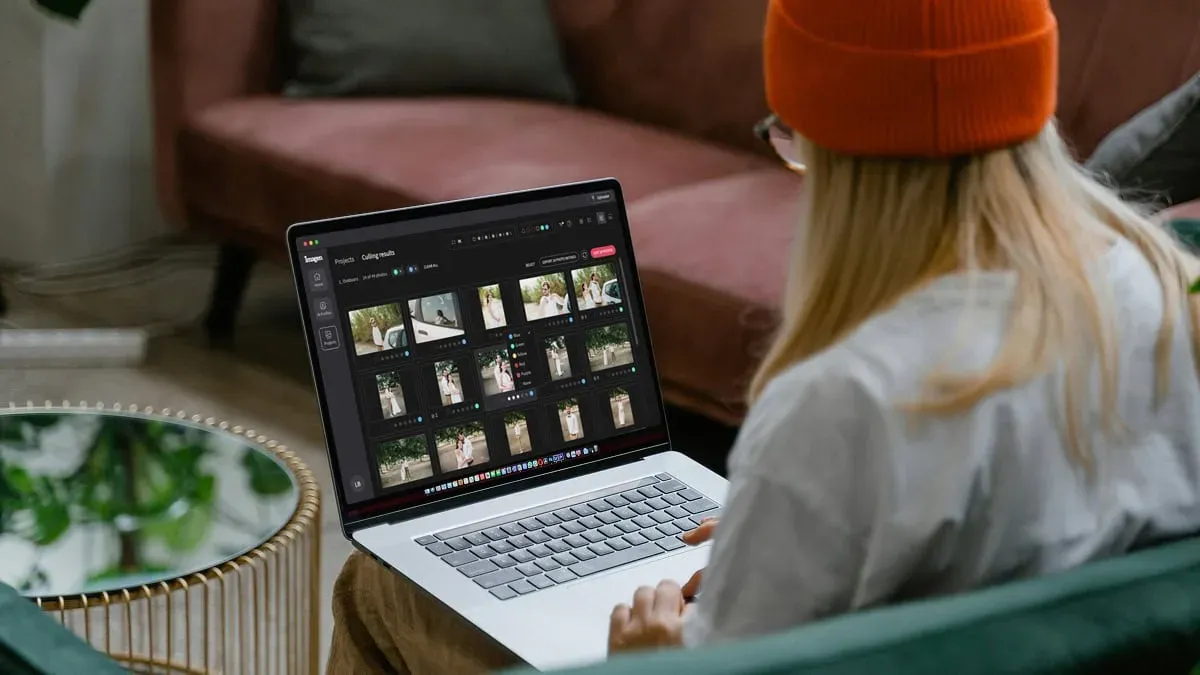
Imagen includes AI culling that ranks frames by sharpness and quality, which helps when a single painting has several similar shots and you only need one or two. You still make the final call, and the tool simply surfaces the strongest candidates first so you spend attention where it counts.
Build a Consistent Color and Tone Baseline
Before you scale anything, decide what a correct reproduction looks like for your work. Pick two or three reference frames that show your ideal exposure, your neutral white balance against a known gray, and your preferred contrast for surface texture. This baseline becomes the target the whole batch matches.
Nail the fundamentals on those references first. Set exposure so the artwork reads true without clipping bright whites or crushing deep blacks. Correct white balance against your gray card so neutral tones stay neutral, which keeps a cool blue from drifting warm. Tune contrast so canvas weave, pencil strokes, and paper texture stay legible. When these references are right, you have taught the AI what color accurate means for your portfolio.
Apply Your Style Across the Full Batch With Imagen
This is the step that used to eat entire days. With a trained personal style, Imagen reads your catalog and applies your color, exposure, white balance, and tone decisions to every remaining frame in the shoot. A 400 image collection comes back edited in minutes, arriving in batches so you can start reviewing early frames while the rest finish, and every frame carries the same look because the same model made every choice.
The practical payoff shows up when a buyer compares your reproductions side by side. Scroll a print shop grid or a gallery portfolio, and the whites stay the same white, the blacks stay the same black, and the brightness never jumps between pieces. That visual consistency is hard to hold by hand across hundreds of frames, and it is exactly what a style engine protects. For a deeper walkthrough of the tool side, see our companion piece on how to edit artwork photos with AI.
Imagen runs on clear pay as you go pricing: you pay for each photo you export. Sliders, crops, and masks you do yourself are always free. Check the pricing page for current rates. Because you pay per image rather than per seat, an artist or a reproduction studio scales cost directly with volume.
Per Photo Finishing for Tricky Surfaces
Batch editing handles the bulk of the work, and then a handful of hero frames deserve individual attention. Different artwork surfaces each pose a specific finishing question, so treat them on their own terms.
- Oil and acrylic on canvas can hold subtle sheen, so check that highlights on raised brushwork stay controlled while the color underneath stays true.
- Watercolor and pastel on paper live in delicate midtones, so protect the soft gradients and keep the paper white honest rather than blown out.
- Graphite and charcoal drawings depend on a clean tonal range, so confirm the deepest darks and the lightest paper both hold detail.
- Glossy prints and framed pieces catch reflections, so inspect for stray light before you finalize the reproduction.
Imagen’s built-in editor (Beta) lets you finish the captured frame by hand with sliders, a histogram, and crop and straighten, which helps on dark matte surfaces and glass where you want to inspect tone closely. This finishing corrects the photo you captured. It does not repaint the artwork, alter the artist’s marks, or add features the piece never had. It is an early release, so a dedicated app can still help with stubborn dust or lint.
Export for Prints, Portfolios, and Online Sales
Once your batch looks consistent, export in the sizes each destination needs. A fine art print lab, a gallery submission, and an online shop each ask for different dimensions and color handling, so plan the outputs before you deliver.
- Export high resolution master files for giclee printing and archival reproduction.
- Create web sized versions with sensible compression so listings load fast on mobile.
- Prepare square and vertical crops for social platforms and print-on-demand storefronts.
- Keep a clean archive of the edited masters so reprints match the original set exactly.
Because the whole batch shares one style, these exports stay coherent no matter where they land. A buyer who sees your print on Instagram and then on your shop page reads the same color and brightness in both places. For the end to end process laid out step by step, our artwork photo editing workflow guide covers the sequence in detail, and you can browse more editing tips on the Imagen valuable tips hub.
Other Tools Worth Knowing
Imagen is built for high volume professional editing where a trained personal style drives the whole batch, and a few other real tools serve related needs. Adobe Lightroom remains the standard catalog and RAW developer, and it pairs well as the place your artwork library lives before and after AI editing. Capture One is a strong tethered capture and color grading choice that many reproduction studios shoot into directly. Adobe Photoshop stays the tool of choice for careful spot cleanup or precise perspective correction on a single hero frame when a project truly needs it.
Each of these carries its own pricing model, from subscriptions to one time licenses, and you can compare current terms on their own sites. The point is not to replace your catalog software. Imagen slots into that existing workflow and automates the slow color and tone editing, so you keep the tools you trust and simply spend far less time matching frames by hand.
What’s new in Imagen: Imagen is now an intelligent, agentic Studio for professional photographers, one project where you cull, edit, review, and export in any order. For artwork collections, your Personal AI Profile applies your look across a shoot, and you can also apply more than one AI Profile to a selected set of photos, which takes some extra processing time. The Studio is currently in beta.
Frequently Asked Questions
Does AI editing change the actual artwork in the photo?
No, it edits the real photo you captured. Imagen adjusts color, exposure, white balance, and tone on the piece you photographed, and its built-in editor (Beta) lets you finish that frame by hand with sliders and presets, while a dedicated app can still help with dust or sensor spots. It does not generate or alter the artwork itself, and it does not invent textures, frames, or backgrounds that were never in front of the lens.
How does Imagen keep a whole collection color accurate?
It learns your personal editing style from your Lightroom or Capture One catalog, then applies the same color, exposure, and tone decisions to every frame in the batch. Because one model makes every choice, a 400 image collection holds the same neutral, color accurate look from the first piece to the last.
What does Imagen cost for artwork photography?
Imagen uses pay as you go pricing: you pay for each photo you export. That lets you test it on a real artwork batch before you commit. Check the pricing page for current rates.
Do I still need Lightroom or Capture One?
Yes, keep your catalog software. Your Personal AI Profile learns from your past edits in Lightroom Classic, and Imagen works alongside your catalog rather than replacing it, so you can keep organizing your artwork library in Lightroom or Capture One, send AI edits back to Lightroom Classic, or export finished JPG, TIFF, or PNG files straight from Imagen.
AI artwork photo editing turns the slowest part of reproduction work into a fast, repeatable step. You photograph honestly, teach the software your style once, and let it carry that color accurate look across the entire collection. Ready to edit your next artwork batch in minutes? Start with Imagen and its new Studio, where you cull, edit, and export in one project, and see your style applied.

