What is AE Lock (Auto Exposure Lock)?
Table of contents
Enhancing Your Photography Workflow with AI: A Professional’s Guide
As a professional photographer, you understand that capturing the perfect shot is only half the battle. The real work often begins after the shutter clicks, in the demanding world of post-production. Culling thousands of images, ensuring consistent edits, and managing tight deadlines can be overwhelming. Fortunately, artificial intelligence (AI) is transforming how we approach these tasks, offering powerful tools to streamline your workflow and help you focus more on your craft and less on tedious hours at the computer.
The Demands of Modern Photography
Today’s photography landscape is more competitive and fast-paced than ever. Clients expect quick turnarounds, and quality standards remain incredibly high. Whether you specialize in wedding photography, real estate shoots, or volume photography for sports and schools, you’re constantly balancing artistic vision with operational efficiency. This balance often leads to late nights spent sifting through images and adjusting settings, eating into personal time and potential new projects.
Challenges in Post-Production
- Time-consuming Culling: After a big shoot, you might have thousands of photos. Deciding which ones to keep and which to discard, especially when dealing with similar shots, can take hours, even days.
- Inconsistent Editing: Maintaining a consistent look and feel across an entire gallery, or even across different projects, is crucial for your brand. Manual editing can lead to variations that are noticeable and detract from your professional image.
- Repetitive Tasks: Many editing tasks are repetitive, like adjusting exposure, white balance, or cropping. These necessary steps, while fundamental, don’t always require creative input and can quickly become monotonous.
- Managing Large Volumes: Handling immense quantities of RAW files requires significant storage, processing power, and organizational skills. The sheer volume can be daunting.
These challenges highlight the need for smart solutions that can assist in managing the workload without compromising quality or artistic control. This is where AI steps in, not to replace your creative decisions, but to empower them.
Streamlining Your Selection Process: AI Culling
Culling is one of the most critical and time-intensive parts of post-production. Going through hundreds or thousands of images, identifying the sharpest, most expressive, and technically sound shots, and eliminating duplicates or blurry frames, demands intense focus. Imagine having a smart assistant that can do the heavy lifting for you, presenting you with only the best options to make your final decisions.
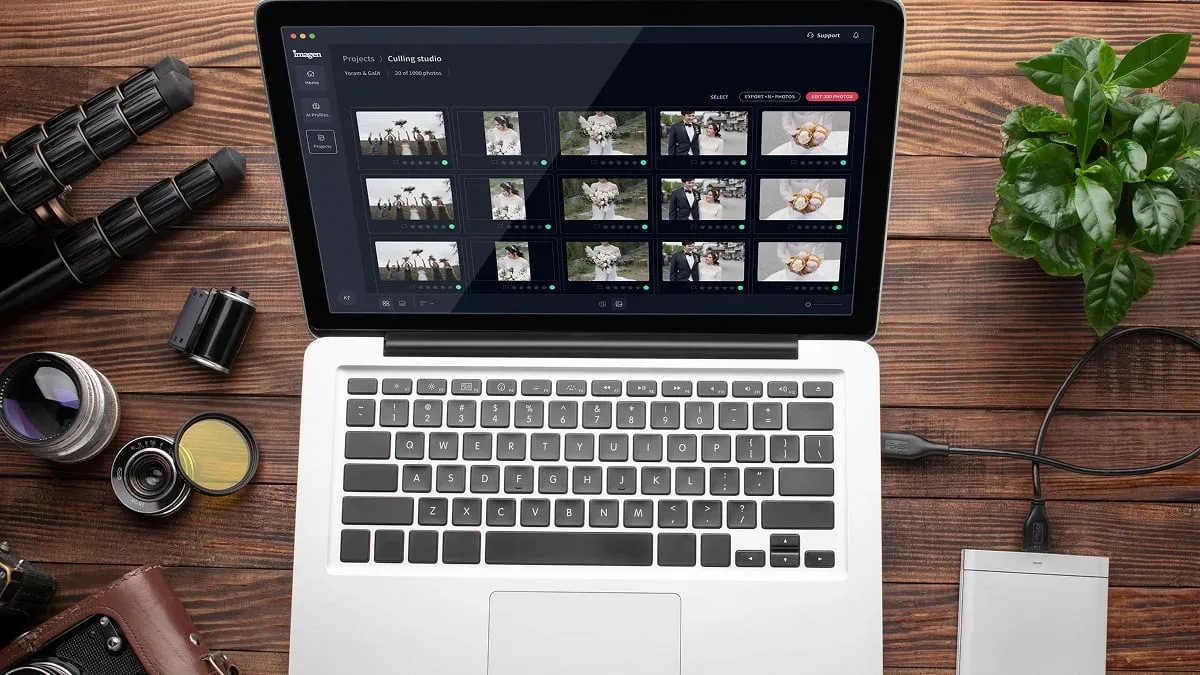
This is precisely what AI culling tools like Imagen’s Culling Studio offer. Instead of manually inspecting every single frame, AI algorithms can analyze your entire catalog, identifying key characteristics that define a “good” photo. This includes factors like sharpness, focus, open eyes, composition, and even duplicate detection.
The process starts by importing your images into a smart culling platform. The AI then quickly scans and categorizes them. For instance, it can automatically tag images as ‘sharp’, ‘blurry’, or identify if someone’s eyes are closed. It can also group similar shots, helping you pick the strongest one from a series with just a glance. This saves you from having to zoom in on every single face or pixel-peep for sharpness.
You remain in control. The AI provides a suggested selection, which you then review. It acts as a powerful first pass, significantly reducing the number of photos you need to scrutinize manually. For a more detailed look at how this transforms your workflow, you can explore resources like Imagen’s Culling Studio reimagined or this comprehensive guide to culling photographs.
By automating the initial sorting, you can slash the time spent on culling, allowing you to move faster to the creative editing phase or take on more projects. This efficiency is a game-changer for anyone dealing with high-volume photography.
Achieving Editing Consistency: AI Photo Editing
Once your images are culled, the next challenge is editing. Every photographer has a unique style, a signature look that defines their work. Replicating this style across hundreds or thousands of photos, ensuring every image in a gallery feels cohesive, is demanding. Manual editing, even with presets, often requires fine-tuning each image, leading to potential inconsistencies and burnout.
AI photo editing addresses this head-on. Tools like Imagen’s Personal AI Profiles learn your unique editing style. How does it work? You train the AI by providing it with a collection of your previously edited images. The AI analyzes your adjustments – your preferences for exposure, white balance, color grading, shadows, highlights, and more – and creates a unique “profile” based on your artistic decisions.
Once your AI Profile is created, you can apply it to new, unedited RAW files. The AI intelligently processes each image, applying your learned style with remarkable precision and consistency. This means whether you’re editing 50 wedding photos or 5,000 sports shots, every image will reflect your distinct look, without the need for manual, image-by-image adjustments. This also extends to correcting issues like overexposed photos with ease, applying your learned style to bring them back to life.
The beauty of this system is that it’s designed to assist, not dictate. You can always make further manual adjustments to images after the AI has applied your profile. It provides a strong, consistent baseline, freeing you to focus on the truly creative retouches that demand your artistic eye. For those looking to dive deeper into how this technology works, check out the power of AI photo editing tools.
The benefit is clear: you gain unparalleled consistency across your work, significantly reduce your editing time, and elevate your professional output. Imagine slashing your editing time by 96%, giving you back precious hours to pursue new projects, engage with clients, or simply enjoy life outside the editing suite.
Beyond Editing: The All-in-One Workflow
Many professional photographers find themselves juggling multiple software applications for different stages of their workflow. One for culling, another for editing, perhaps another for file management or client delivery. This fragmented approach can lead to inefficiencies, compatibility issues, and the frustrating experience of “getting lost between software.”
The true power of AI in photography comes when these individual tools are integrated into a cohesive, all-in-one platform. Imagen offers a comprehensive suite designed to simplify your entire post-production workflow, from start to finish. This means you’re not just getting AI culling or AI editing; you’re getting a connected experience.
Consider the integrated workflow:
- Ingestion: Upload your RAW files directly to the platform.
- AI Culling: Use Imagen’s Culling Studio to quickly sort and select your best images, powered by intelligent AI.
- AI Editing: Apply your unique Personal AI Profile to the culled images, ensuring consistent, high-quality edits across the entire selection.
- Review and Refine: Make any final manual tweaks to specific images if needed, adding your artistic touch where it matters most.
- Delivery: Your finished images are ready.
This integrated approach allows for seamless transitions between culling and editing, reducing friction and saving valuable time. Components like Culling, AI Editing, and Cloud Storage aren’t just standalone features; they work in concert to create a streamlined, efficient post-production pipeline. This holistic view of your workflow helps you stay organized, maintain consistency, and deliver exceptional results faster than ever before.
Furthermore, platforms are starting to explore beyond photos. For example, the developments from AI photo to AI video editing hint at an even broader integration in the future, providing a single solution for all your media needs. Understanding the benefits of batch photo editing is just one step towards embracing this comprehensive approach.
Practical Applications of AI in Photography
Let’s look at how AI can practically impact different types of professional photographers:
Wedding and Event Photographers
You often shoot thousands of images at a single event. Culling can be a nightmare. AI helps you quickly filter out blinks, blurry shots, and duplicates, presenting you with the best moments from the day. Then, your Personal AI Profile ensures every image, from ceremony to reception, has that signature romantic or vibrant look your clients adore.
Real Estate Photographers
Consistency is key for property listings. AI can apply uniform exposure, white balance, and color corrections across all interior and exterior shots, ensuring every room looks its best and maintains a professional aesthetic. This speed means you can photograph more properties in less time.
Portrait and Editorial Photographers
While your work is highly artistic, repetitive tasks like skin smoothing or basic color correction can still be delegated to AI. This frees you to concentrate on the finer, more creative retouching that defines your unique style.
Volume Photographers (Sports, Schools)
This is where AI truly shines for efficiency. Imagine shooting thousands of student portraits or action shots. AI culling can quickly select the best poses or sharpest action, and AI editing can apply consistent color and exposure corrections across the entire school’s gallery, saving immense amounts of time and ensuring consistent quality for every parent.
Looking Ahead: The Future of AI in Photography
AI’s role in photography is continually evolving. We’re already seeing the integration of AI into more advanced tasks, and the trajectory suggests even deeper capabilities are on the horizon. The goal isn’t to replace the human element but to augment it, providing tools that enhance creativity and efficiency.
As AI continues to learn and adapt, we can expect even more sophisticated assistance:
- Enhanced Creative Tools: AI might offer intelligent suggestions for cropping or composition based on photographic principles, helping you see new possibilities in your images.
- Predictive Editing: Imagine AI anticipating your next editing move based on your past habits, or even suggesting minor adjustments to an image before you even think to make them.
- Adaptive Styles: AI profiles could become even more dynamic, subtly adjusting to different lighting conditions within a single shoot to maintain a consistent feel.
- Integration with Video: Just as AI is revolutionizing photo editing, it’s making strides in video editing, offering consistency across both stills and motion.
The conversation around how AI will affect the future of photography editing is exciting. It’s about empowering photographers to achieve more, with less effort, and to deliver breathtaking results consistently. Embracing these technologies means staying at the forefront of the industry and ensuring your business remains competitive and profitable.
Conclusion
As a professional photographer, your time is your most valuable asset. The integration of AI into your workflow, particularly through comprehensive platforms like Imagen, offers a tangible path to reclaiming that time without compromising on the quality or consistency of your work. By intelligently automating repetitive and time-consuming tasks like culling and basic editing, AI allows you to focus on the artistic aspects of photography that you love most.
The future of photography is one where technology works in harmony with human creativity. By embracing AI, you’re not just adopting a tool; you’re investing in a more efficient, consistent, and ultimately more rewarding professional journey. Explore how AI can transform your workflow and unlock new levels of productivity and artistic freedom.