

Building a Faster Portrait Retouching Workflow for Concert Photographers
Table of contents
- Why stage portraits are harder to retouch than studio work
- What genuinely needs retouching on a performer’s skin
- Where to draw the line: retouching versus altering the artist
- How AI batch editing removes the retouching bottleneck
- A step-by-step concert retouching workflow
- Keeping skin tone consistent across a changing lighting rig
- What it costs and how the time math works out
- Delivering fast without cutting corners
- Frequently asked questions
Concert photography lives and dies by the close-up. The wide crowd shots and light-show frames matter, but the images an artist actually licenses, and the ones a magazine or promoter picks up, are the tight stage portraits: the singer mid-note under a hard top light, the guitarist lit half in shadow, the drummer with sweat catching the spots. Those frames need portrait-grade retouching, and after a two-set night you can walk away with hundreds of them. The fastest workflow treats retouching as a batch job with a consistent recipe, not a per-frame art project. That means grading your whole take in one pass, letting an AI profile handle the repetitive skin work in your own style, and reserving your manual time only for the handful of hero frames that will be printed large.
This guide walks through a retouching workflow built specifically for stage portraits: what actually needs fixing on a performer’s skin, how to keep tone and color consistent across a chaotic lighting rig, and where AI batch tools remove the bottleneck so you can deliver the next morning instead of the next week. It also draws a clear line between the skin work that is genuinely fair game and the changes that cross into misrepresenting an artist.
Why stage portraits are harder to retouch than studio work
A studio portrait gives you controlled, even light and a subject who is holding still. A concert gives you neither. The lighting is designed for the audience and the video screens, not for your sensor, so you are shooting under saturated color washes, hard top lights, and beams that change every few seconds. On a performer’s face that produces a specific set of problems you will see again and again.
The first is shine. Stage lights are hot, the set is physical, and by the third song most artists have a sheen of sweat across the forehead, nose, and cheekbones. Under a strong key light that reads as bright specular hotspots that pull the eye away from the expression. The second is color cast on skin. A deep red or magenta wash can leave a face looking flushed or blotchy, and a hard blue can drain it. The third is texture exaggeration. A raking top light rakes across pores, stubble, and any blemish, throwing hard little shadows that make normal skin look rougher than it is. None of these are flaws in the person. They are artifacts of the room, and fixing them is exactly what retouching is for.
What genuinely needs retouching on a performer’s skin
Keeping the scope honest keeps your workflow fast, because a tight definition of “done” stops you fiddling. For stage portraits, the legitimate skin work is a short list.
- Even out shine and hotspots. Bring down the specular sweat highlights on the forehead, nose, and cheekbones so the skin reads as lit rather than glaring.
- Reduce redness and de-redden tones. Calm the flush that a red or magenta wash pushes into the skin, and even out blotchiness from heat and exertion.
- Light skin smoothing. Soften the harshness that a hard top light exaggerates in pores and texture, without turning skin plastic.
- Remove transient blemishes and spots. A stray breakout, a bit of smeared stage makeup, a piece of lint on a dark shirt near the jaw. Temporary things that were not there the week before and will not be there the week after.
That is the whole job for the vast majority of frames. It is skin cleanup and tone correction, and it is repetitive in the best way: the same handful of moves applied consistently across an entire set.
Where to draw the line: retouching versus altering the artist
Music photography carries a reputation for honesty. The audience was there, the performance was real, and artists and their teams are sensitive to images that change how they actually look. So the fast, defensible workflow keeps a firm boundary. Evening skin tone, calming redness, smoothing texture, and clearing a temporary blemish all fall inside it. They present the performer as they looked that night under better light.
The moves that fall outside it are the ones that change the person rather than the lighting. Reshaping a body or refining a jaw with a liquify tool, adding heavy makeup that was not worn, changing facial structure, or compositing objects into or out of the frame all cross from retouching into altering the artist. That work is a separate, deliberate, manual decision and it is not part of a batch skin-cleanup pass. Building your workflow around the honest list keeps you both fast and safe, because you never have to relitigate what a given edit was trying to do.
How AI batch editing removes the retouching bottleneck
The reason concert retouching drags is volume plus repetition. You are applying nearly the same corrections to hundreds of near-identical faces, by hand, one at a time. That is exactly the shape of problem AI batch editing is built for. A tool like Imagen’s AI photo retouching software learns your personal editing style from your own past work, then applies that style across a whole shoot in one pass: the base grade for color and tone, and the portrait retouching on top of it. Automated skin smoothing, blemish and spot removal, evening and de-reddening of skin tones, all applied consistently in the look you already use, at volume, fast.
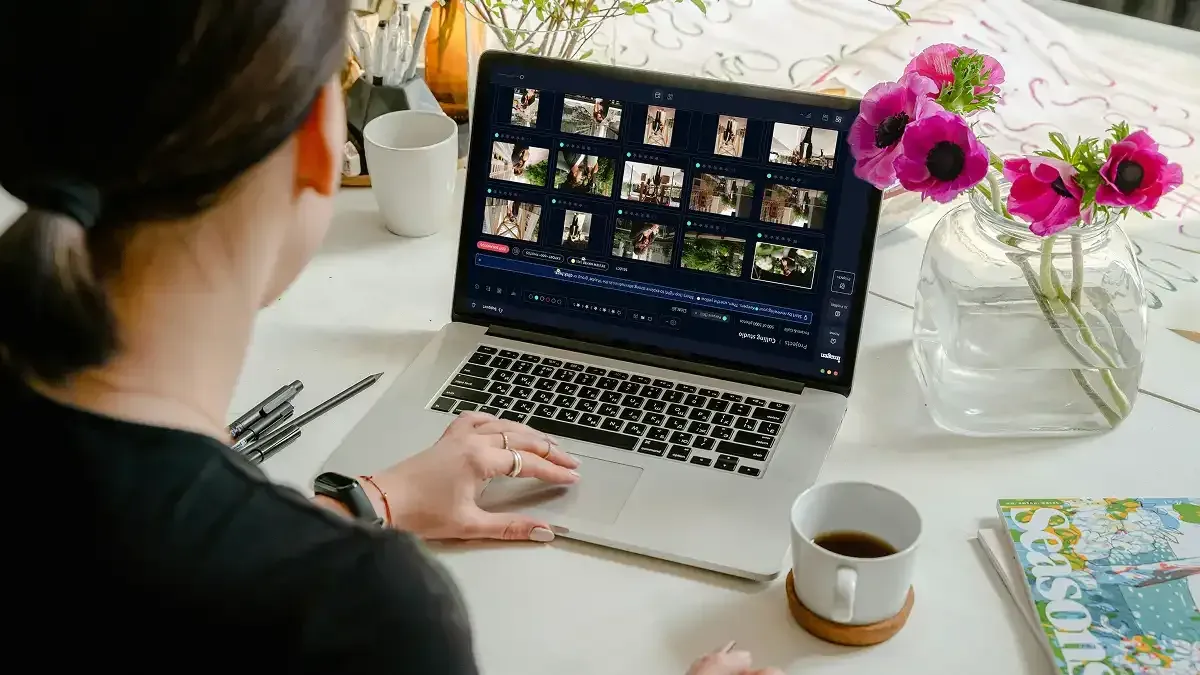
The important word there is consistent. When a human retouches four hundred frames over several evenings, the corrections drift; the last set never quite matches the first. An AI profile applies the same recipe to frame one and frame four hundred, which is what you want for a gallery an artist will scroll through in one sitting. It reads as one shoot rather than a patchwork. Imagen is a desktop app for Mac and Windows that works on your RAW files with the AI processing in the cloud, offers AI culling to thin the take before you even start (or free manual culling if you prefer), and has edited photos arrive in batches as they process, so you can start reviewing early frames and turn a whole night around fast enough to deliver the next morning while the show is still fresh.
What it deliberately does not do is the line-crossing work above. AI batch retouching handles skin and tone. It is not the place for reshaping bodies, inventing makeup, or removing a mic stand from the frame. Those stay a manual choice, and keeping them out of the automated pass is a feature, not a gap.
A step-by-step concert retouching workflow
Here is the sequence that turns a night’s take into a delivered gallery with the least hands-on time.
- Ingest and back up. Pull the cards, copy to two locations, and get the RAW files somewhere you can work from. Never start editing on a single copy.
- Cull first. A concert take is full of near-duplicates from burst shooting and blinks caught mid-note. Thin it down to the keepers before you spend any retouching effort. Culling first is the single biggest time saver, because every frame you cut is a frame you never edit.
- Apply your base grade in batch. Run your color and tone profile across the whole set so exposure and white balance are consistent before any skin work happens. Fixing the wash-driven color cast at this stage makes the skin corrections easier.
- Run portrait retouching in batch. Apply the skin pass in your style across the set: shine control, de-reddening, light smoothing, spot removal. This is the step AI batch tools collapse from hours into a single pass.
- Hand-finish the hero frames. Pull the ten or fifteen images that will be the artist’s picks and the press shots, and give them individual attention: a closer look at the eyes, a stray hair, a highlight that the batch pass did not fully tame.
- Export and deliver. Push web-sized proofs for fast selection and keep full-resolution files ready for the frames that get chosen for print or licensing.
The whole point of the order is that batch handles the many and your hands handle the few. You are not retouching four hundred frames. You are retouching a dozen, and reviewing the rest.
Keeping skin tone consistent across a changing lighting rig
Consistency is the hardest thing to hold by hand and the easiest thing to get from a profiled batch. Across a single song the key light might shift from warm amber to hard white to deep blue, which means the same face arrives at your editor in three different color temperatures. If you correct each frame independently by eye, the gallery ends up looking like three different shoots stitched together.
The fix is to standardize the target rather than the source. Decide what neutral, healthy skin should look like in your delivered images, and let the batch grade pull every frame toward that target regardless of what the stage light was doing. An AI profile trained on your own edits already encodes that target, which is why running the whole set through one pass produces a gallery that feels coherent even though the lighting on stage was anything but. Then your hero-frame finishing is about polish, not about rescuing color from scratch.
What it costs and how the time math works out
The economics of a batch workflow are simple once you count the hours. Manual portrait retouching on a large concert take is where the night’s real cost hides, because your time is the expensive part. Moving the skin-and-tone work to a batch pass converts most of that manual labor into a flat, predictable per-image processing cost.
Imagen’s photo editing runs on pay-as-you-go pricing, a monthly base fee plus a charge for the photos you export. For a set of a few hundred keepers, that is a predictable line item against the hours you would otherwise spend clicking through faces one at a time. The relevant comparison is not the export charge in isolation; it is that charge against your hourly rate multiplied by the frames you would have hand-retouched. For many concert shooters, the batch pass earns its cost back quickly, and the real win is turnaround: delivering the morning after the show, while the artist’s team is still posting about the night, instead of a week later.
Delivering fast without cutting corners
Speed in concert work is not just convenience, it is competitive. Artists, labels, and venues want images while the event is current, and the photographer who delivers first often gets the repost, the credit, and the next booking. A batch workflow is what makes fast delivery possible without dropping quality, because the consistency comes from the profile rather than from you rushing.
The pattern that holds up: cull hard, grade and retouch the whole set in batch in your own style, hand-finish only the heroes, and deliver proofs the next morning. To set up the retouching engine that does the batch skin work, start at Imagen and its new Studio, where you cull, edit and export in one project, and build a profile from your existing edited concert work so the automated pass already looks like you. If you want to explore related parts of the pipeline, our guides on culling large event takes and building consistent color profiles cover the steps that feed into this one.
What’s new in Imagen: Imagen is now an intelligent, agentic Studio for professional photographers, where you cull, edit, review and export in one project, in any order. After a concert, edited photos arrive in batches as they process, so you can start reviewing the opening frames while the rest of the set finishes, and AI filters such as blur and closed eyes help you narrow the take first. The Studio is rolling out gradually as a beta.
Frequently asked questions
Is AI skin retouching appropriate for music photography given its honesty norms?
Yes, as long as you keep it to skin and tone. Evening out sweat shine, calming redness from stage washes, light smoothing, and removing a temporary blemish all present the performer as they looked that night under better light. That is squarely within the retouching tradition. The line to hold is against changing the person: no no invented makeup, no facial-structure changes, and no adding or removing objects. Keep the automated pass to honest skin cleanup and you stay on the right side of the norm.
How does an AI tool keep my retouching in my own style?
Tools like Imagen build a personal profile from your own previously edited images, learning the color, tone, and skin choices you already make. When you run a new shoot through it, the batch pass applies that learned style rather than a generic preset, so the output looks like your work at volume. The more of your real edited concert portraits the profile is trained on, the closer the automated pass lands to what you would have done by hand.
What should I retouch by hand instead of in batch?
Reserve manual work for two things. First, the hero frames: the ten or fifteen images that will be the artist’s picks or press shots, where a closer look at eyes, stray hairs, and specific highlights is worth the time. Second, any deliberate creative decision that goes beyond skin and tone, which by definition should not be automated. Everything else, the repetitive shine, redness, and spot cleanup across the full set, is what the batch pass is for.
How much can a batch workflow cut my delivery time?
The savings come from volume. Instead of retouching every keeper individually, you cull, run one batch grade and one batch retouching pass across the whole set, and then hand-finish only a dozen or so frames. For a take of several hundred images, that turns multiple evenings of clicking into a single processing pass plus a short finishing session, which is what makes next-morning delivery realistic. With pay as you go, a monthly base fee plus a charge for the photos you export, the processing cost is small against the hours saved.

